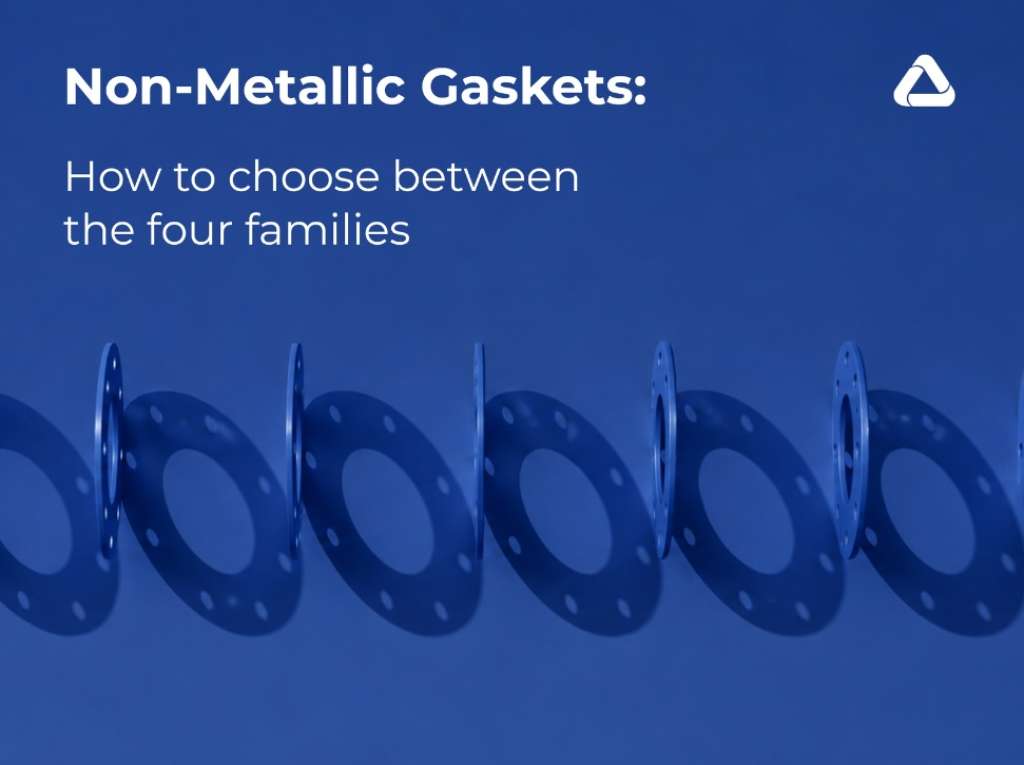
When choosing a flange gasket, the starting point is not the product but the service: which fluid, at what temperature, at what pressure. Carrara’s non-metallic gaskets, backed by over 35 years of experience, come in four material families, each designed to answer a different question.
- Planigraph™ (expanded mineral graphite): operates from -200 to +550 °C and withstands almost all fluids, with one precise limit: oxidizing agents. With weakly oxidizing agents and hot air, temperature must be limited to 450 °C. Available in several versions (LG, LGR, LGRF, LGRHDI), with or without metal inserts: the inserts determine the maximum allowable assembly load.
- Planix™ Megatherm (mica and vermiculite): it starts where graphite ends. Designed for high-temperature services with oxidizing fluids, typical of flue gas systems and boilers. Phlogopite mica or vermiculite, with or without perforated SS316L reinforcement; the unreinforced version is also suitable as an insulating material, thanks to the high dielectric value of mica.
- Planiflon™ (PTFE): the answer when chemistry is the problem. From -200 to +260 °C, with a pH range of 0-14. The range includes modified PTFE with different fillers (silica, hollow glass microspheres, barium sulphate), microcellular versions and expanded PTFE (E12). The manufacturing process is designed to minimize creep and cold flow, the well-known limit of conventional PTFE: we covered it in detail in our article on creep in PTFE.
- Planiflex™ (compressed fiber): asbestos-free, made of organic and inorganic fibers bound with NBR. Suitable for vapors, lubricants, solvents, gases, steam and many diluted acids and alkalis, within 300/600 lbs and PN16/40 ratings. Depending on the model (PF41, PF63, PF64, PF65, PF81), continuous temperature ranges from 140 to 330 °C and pressure from 40 to 120 bar. It can also be used together with PTFE envelopes.
The four families are not interchangeable options on the same level: they divide the field according to the service. Graphite for high temperatures with non-oxidizing fluids; mica or vermiculite when the fluid is oxidizing and the temperature high; PTFE when chemical aggressiveness is the main challenge; compressed fiber for general services with oils, gases and steam.
Complete values for each product, and the related application limits, are given in the technical data sheets.
There is no such thing as the most resistant gasket in absolute terms: there is the one that answers the question the service poses.