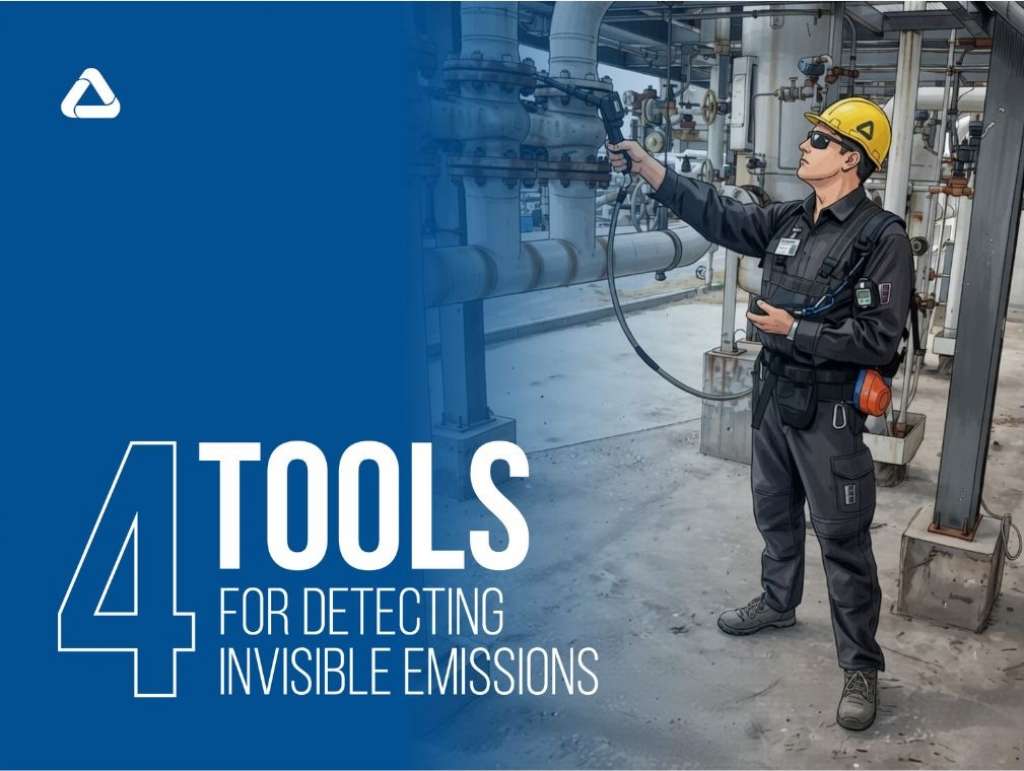
An inorganic gas leaking from a valve makes no sound, has no colour, leaves no visible trace. And yet it is there. The operational question is always the same: which instrument do you use to find it?
Field monitoring of inorganic fugitive emissions demands an instrumentation choice that is never neutral. Each available technology responds to different detection principles, has its own optimal application range, and carries specific limitations. Choosing the wrong instrument means obtaining inaccurate data.
The multi-gas electrochemical detector
It is one of the most widely used instruments in field inspection activities. It measures inorganic compound concentrations through interchangeable, gas-specific sensors: a single portable device can be configured for ammonia, hydrogen sulphide, hydrogen and other compounds, simply by swapping the installed sensor.
Its primary strength is precise leak localisation: operating directly in proximity to the component, it identifies the exact emission point with precision. It is a handheld, lightweight instrument, well suited to systematic inspections of valves and flanges within LDAR programmes.
Its equally defined limitation is that it requires frequent calibration, and measurement accuracy depends significantly on the target compound and the operating conditions.
The single-gas electrochemical detector
Where the source is known and the contaminant is a single compound, the single-gas detector is the most direct solution. Designed to measure one compound, it delivers high accuracy on the target gas in a compact, cost-effective device.
It is the right choice for sites characterised by a specific and recurring contaminant, where operational simplicity is as valuable as technical precision. The constraint is structural: in environments with multiple potential sources, this approach alone is not sufficient.
FTIR spectrometer
The Fourier transform infrared analyser is capable of detecting and measuring up to fifty inorganic compounds simultaneously from a single sample. Response is fast and accuracy is high across a broad spectrum of target gases.
It is the instrument designed for complex environments, where the variability of emission sources makes multi-compound reading essential. Its use is well established in plant-level environmental assessments. Limitations may include greater bulk and weight, which constrain portability in the field, and environmental variations that can reduce measurement reproducibility.
The PID detector
The photoionisation detector uses a UV lamp to ionise the sampled gas, generating an electrical signal proportional to the detected concentration. It offers high sensitivity and immediate response, with a point-specific measurement on the component being inspected.
In the context of inorganic emissions, its application range is narrower than electrochemical instruments. Readings are taken against a reference gas and require the application of correction factors to derive the actual concentration of the target compound. It is not a direct-identification instrument: it measures a signal, not a compound.
Which one to choose?
There is no universally superior instrument. The choice depends on the type of plant, the nature of the compounds present, the operating conditions and the objectives of the monitoring programme. In many operational contexts, the most effective answer is not a single instrument but a measurement strategy that integrates complementary technologies, ensuring the quality of the result.
Through its FERP division, Carrara operates directly in inorganic fugitive emission monitoring activities on industrial plants, from the correct instrument selection through to the quantification of emissions according to the relevant reference protocols. Supporting clients throughout the entire activity cycle and delivering the best achievable results.